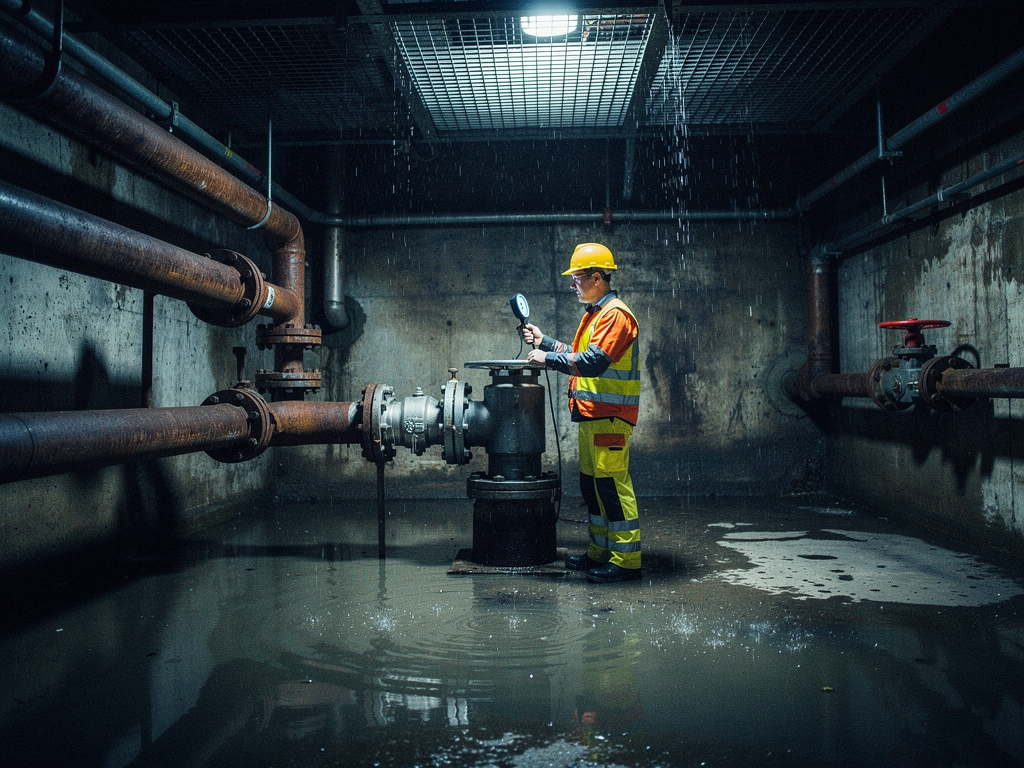
During a sudden downpour, a mainline pressure sensor records a rapid dip to 1.2 bar, while the downstream flow meter continues to register 250 L/min, a level that matches the previous dry-day average. The SCADA alarm flags a possible burst, yet field crews find no visible rupture and the water quality remains unchanged. The underlying cause is the infiltration of storm runoff into the low-lying pipe, which depressurizes the network without adding measurable volume. Operators, relying on the aggregate flow figure alone, assume the system is stable and miss the subtle leak that could expand under sustained low pressure.
How Monsoon Rain Alters Pressure Dynamics in Distribution Mains
Heavy rain raises the groundwater table, increasing hydrostatic pressure on buried conduits; this external load squeezes the pipe wall inward, reducing the internal gauge pressure recorded by transducers at zone inlets. A pressure transducer that logs every five minutes will show a night-time minimum that is consistently 0.3 bar lower than the historical baseline for three consecutive intervals, even though no demand change has occurred. The drop is not a demand-driven dip but a mechanical response to soil saturation, and it persists until the water table recedes.
Because the pressure reduction is uniform across a zone, the calculated hydraulic grade line shifts downward, causing the flow equation to predict a lower velocity for the same discharge. Operators who interpret the lower pressure as a sign of reduced consumption will unnecessarily throttle pumps, increasing the risk of cavitation in centrifugal units. Continuous monitoring of pressure trends alongside soil moisture probes reveals the correlation, allowing the control system to compensate by adjusting pump curves rather than misreading the demand.
Why Infiltration Generates False Readings in Flow Meters
When stormwater seeps through joint defects, it enters the pipe at low velocity, mixing with the potable stream and adding a few hundred liters per hour that are below the resolution of standard ultrasonic flow meters. The meter’s digital output therefore remains unchanged, showing a steady 250 L/min, while the actual delivered volume to consumers is slightly higher. In the data log, this manifests as a flat flow line during the rain event, juxtaposed against a falling pressure curve.
Advanced meters equipped with temperature compensation can detect the cooler infiltrating water as a minor deviation in bulk temperature, but most utilities ignore this secondary signal. The result is a hidden increase in unaccounted-for-water (UFW) that only becomes apparent in the monthly reconciliation, where the UFW spike coincides with the monsoon weeks. Recognizing the pattern-stable flow, falling pressure, and a subtle temperature dip-enables engineers to flag potential infiltration zones for targeted inspection.
How Shifting Demand Patterns During Heavy Rain Mask Leaks
Rainfall induces a behavioral demand shift: residential users reduce tap usage for drinking and cooking, while outdoor irrigation demand drops to near zero. The aggregate demand curve flattens, and the night-time baseline consumption falls by 15 percent compared with the dry season. Simultaneously, a small pipe crack may be leaking 5 L/min, a rate that would be obvious against a normal 200 L/min night flow but becomes invisible when the baseline itself has dropped.
When operators apply a simple leak detection rule-such as “flag any zone where night flow exceeds the historical minimum by more than 10 percent”-the rule fails because the historical minimum itself has been depressed by the rain. The leak remains hidden, and the utility records a lower overall loss, giving a false sense of performance improvement. Incorporating a demand-adjusted threshold, where the expected night flow is scaled by the observed rainfall intensity, restores the sensitivity of the detection algorithm.
Signature of a Genuine Burst Event Versus a Weather-Driven Pressure Fluctuation
A true pipe burst generates a characteristic pressure waveform: an abrupt drop of 0.8 bar or more within a single five-minute interval, followed by a rapid rise as the control valve at the zone inlet opens to maintain service pressure. The flow meter, in contrast, spikes sharply to 400 L/min or higher, sustaining that level for at least ten minutes before the system’s pressure stabilizes. This dual-signal pattern-sharp pressure dip plus sustained high flow-is the hallmark of a rupture.
By contrast, a weather-induced pressure dip shows a gradual decline of 0.2-0.3 bar over several intervals, with no corresponding flow surge; the flow reading may even dip slightly as demand drops. The pressure then recovers slowly as the groundwater level falls. Plotting pressure and flow together on a synchronized time axis makes the distinction clear, allowing the SCADA alarm to suppress false positives during monsoon periods.
Why Pump Runtime Data Becomes More Diagnostic Than Flow Data in the Monsoon
During sustained rain, the reduction in pressure forces the primary booster pump to run longer to meet the statutory service pressure of 2.5 bar at the network outlet. The pump’s runtime logger records an increase from the typical 4 hours per day to 7 hours, while the flow meter shows only a marginal change. The extended runtime indicates that the system is compensating for external hydraulic losses rather than an increase in consumer demand.
When a burst occurs, the pump runtime spikes even higher-often exceeding 9 hours-as the controller repeatedly attempts to restore pressure against the loss of water. This creates a distinct runtime signature: a step increase followed by a plateau at a new higher duty cycle. Operators who monitor pump motor current and runtime can therefore detect a burst earlier than they could by waiting for flow anomalies, which may be masked by the rain-induced demand shift.
How Continuous Monitoring Drives Different Operational Decisions in Monsoon Season
Utilities that ingest pressure, flow, temperature, and pump runtime streams at fifteen-minute intervals can apply a composite rule set that distinguishes infiltration, demand shift, and rupture. For example, when the pressure dip exceeds 0.5 bar, flow remains within ±5 percent of the zone average, temperature drops by 0.3 °C, and pump runtime rises by more than two hours, the system classifies the event as infiltration and schedules a targeted leak survey.
Conversely, if the same pressure dip coincides with a flow surge above 350 L/min and pump runtime spikes above eight hours, the algorithm escalates the alarm to a burst response, dispatching crews within thirty minutes. This nuanced decision matrix reduces unnecessary field trips during rain, cuts response time for true emergencies, and improves the accuracy of the monthly water balance. The result is a clearer picture of what the network is actually doing, rather than what the aggregated monthly reports suggest.
Why Utilities Miss the Real Leak Without Seasonal Context
When the monsoon ends, the groundwater level falls, and the external load on the pipes disappears, causing pressure to rebound to pre-rain levels. If the utility relies solely on end-of-month loss calculations, the hidden leak that persisted through the rain will appear as a modest increase in UFW, easily attributed to normal variation. The missed opportunity is the period when the leak could have been isolated and repaired before it grew larger under the low-pressure conditions.
Embedding seasonal baselines-pressure, flow, temperature, and pump runtime trends specific to monsoon weeks-into the analytics platform provides the missing context. Engineers can then compare real-time readings against these baselines, instantly spotting deviations that signal a genuine fault. Without this context, the utility operates blind, reacting only to aggregate metrics that conceal the short-term dynamics critical for timely leak mitigation.